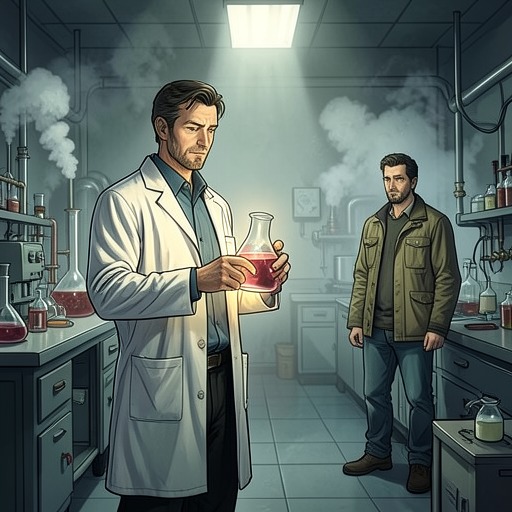
Crystal methamphetamine
Dead ShotCrystal methamphetamine is the illicit substance around which Statenville’s hidden economy, federal investigation, and public deception converge. It is manufactured and transported through Cloverdale Industries’ extensive distribution network, concealed behind the appearance of a legitimate producer of healthcare and vitamin products. In the novel’s most consequential reversal, methamphetamine is also used as the carrier for a chemical marker intended to map a drug network; a rogue alteration turns that surveillance method into a fatal contaminant, killing three high-school student-athletes and exposing the destructive overlap between organized crime, institutional secrecy, and reckless experimentation.
Appearance and Concealment
Crystal methamphetamine first appears through concealment rather than open handling. During the escape and investigation involving Cal Murphy and Kelly Mendoza, Cal opens a package whose label suggests “Clean and Clear,” but the bottle contains white crystals instead of cleaning liquid. Kelly identifies the substance as crystal meth. The contrast between the harmless commercial label and the illicit contents condenses the novel’s larger pattern: ordinary packaging, respectable business fronts, and official explanations conceal a dangerous underlying operation.
Cloverdale Industries presents itself as a facility producing healthcare and vitamin products for mass consumption, yet its distribution network also transports drugs. The company’s language deliberately softens the reality. Its personnel prefer to describe the product as something closer to vitamins than drugs, a verbal maneuver that mirrors the broader effort to make criminal commerce appear compatible with civic prosperity. Crystal methamphetamine is therefore not merely a contraband object; it is the concealed material basis of Statenville’s apparently stable economy.
The Drug Network and Local Power
The methamphetamine trade extends beyond a single hidden room or isolated dealer. Cloverdale Industries operates with vehicles capable of moving product throughout the Pacific Northwest while remaining difficult to detect. Rumors in Seattle, Portland, and Salt Lake City describe Statenville as the site of a drug plant with near-commercial production capacity. The scale of the operation explains why the town’s secret requires cooperation among corporate leaders, local authorities, paid employees, and people responsible for distribution beyond state lines.
Nathan Gold controls Statenville through obedience backed by money and violence, while the local system protects the company and suppresses information about the drug trade. Guy Thompson, once a newspaperman seeking a peaceful life, receives a brown paper bag containing one hundred twenty-dollar bills every month in exchange for treating Statenville as a sleepy town and refusing to investigate its “hallowed secret.” His silence makes him part of the system even though he never fully understands the secret. The same structure turns ordinary civic life into cover: Rotary Club dinners, Garden Club appearances, and mayoral politics coexist with the movement of crystal methamphetamine.
Gold’s control depends on keeping knowledge scarce. Employees are subjected to rigorous background checks and warned that disclosure would cost them their substantial paychecks and could send them to federal prison. Yet the system’s security is not absolute. Buddy Walker, posing as a basketball coach seeking temporary work to support his elderly mother, passes the screening despite minor encounters with the law. His apparent ordinariness allows him access to Cloverdale Industries and eventually to the company’s most protected information.
The Marker Experiment
The federal investigation originally involved a chemical-marker program designed to track the reach of drug distribution. The marker was to be inserted into random batches of drugs so that an unusual medical pattern would alert the Centers for Disease Control and Prevention, allowing the Federal Bureau of Investigation to obtain basic information about the network’s spread. Earlier field tests in Seattle, Los Angeles, and Phoenix had already produced deaths among users who received tainted doses, and the program was formally abandoned after those results.
The dangers were known even more starkly from animal testing. Monkeys reportedly became so distressed that they nearly tore themselves apart, while dogs scratched and clawed themselves to death. Officials concluded that the idea might work in theory but failed the ethical standard required for testing on human beings. The program’s history establishes that the fatal potential was not an entirely unforeseeable accident; the institution had already encountered evidence that the marker could produce extreme suffering.
Walker nevertheless believed his minor in chemistry gave him enough knowledge to challenge the bureau’s professional conclusions. He persuaded Elliott Mercer to help insert marker chemicals into Cloverdale drug batches. At first, Walker used too little material to make an entire shipment traceable. He then chose a more concentrated and reckless test: a batch of drugs found in Riley Gold’s car. Because the coaching staff knew that several players had recently begun using drugs, Riley seemed to Walker an accessible subject through whom the experiment might be observed.
Walker’s objective was to create enough of a medical disturbance to trigger official detection, not to kill. But he failed to control the compound’s effects. He did not adequately consider that the altered chemistry might transform methamphetamine from a carrier of information into an instrument of death. Mercer warned him, yet Walker continued, driven by impatience and the desire to deliver a major success for the bureau. The experiment thus combines investigative purpose with unauthorized human exposure, turning a surveillance technology into an act of lethal irresponsibility.
Deaths and Exposure
The marker was meant to imitate the sudden onset of a rare disease and thereby generate a signal for public-health authorities. According to the later FBI examination, the marker itself—not the methamphetamine alone—caused the deaths. The additive forced liver bile rapidly into the bloodstream, producing uncontrollable itching beneath the skin. Already intoxicated by methamphetamine, all three victims scratched themselves to death.
The first deaths of the local high-school football stars begin as an apparent overdose story. Local residents are told that the student-athletes died from meth, while local law-enforcement officials pressure the coroner’s office to issue falsified reports. On Tuesday, however, independent examination by FBI officials identifies the chemical markers as the actual cause. One victim is Riley Gold, Nathan Gold’s son. His death transforms the drug’s role in the plot: the commodity protected by Gold’s network becomes the vehicle through which the network’s own reckless methods destroy one of its heirs.
Gold and local officials choose to describe the deaths as coincidence rather than draw attention to Statenville. Their response preserves the public fiction that the town is orderly and prosperous, but it also reveals the moral logic sustaining the operation. The fewer people who know, the easier it is to prevent conscientious objection; money makes silence appear practical, and blood money is accepted as the price of preserving a perfect small-town image.
Narrative Significance
Crystal methamphetamine links the novel’s material, institutional, and ethical conflicts. It is a product manufactured under a corporate façade, a resource moved through a regional criminal network, evidence sought by undercover agents, and a substance whose adulteration produces irreversible consequences. Every attempt to control its meaning creates another layer of concealment: Cloverdale calls drugs vitamins, officials call deaths overdoses, and the town treats a systemic crime as an unfortunate coincidence.
The object also exposes the instability of the boundary between law enforcement and criminal practice. The Federal Bureau of Investigation seeks to trace Cloverdale’s distribution system, but Walker’s unauthorized experiment reproduces the danger it claims to investigate. The methamphetamine shipment becomes a site where criminal enterprise, scientific ambition, bureaucratic secrecy, and political self-protection meet. Its significance lies not only in what it does to users, but in what powerful institutions do through it—and what they subsequently refuse to admit.